7 Ways to Supercharge Your Soil (and Save the Planet While You’re At It)
I’ve spent years talking to farmers, soil scientists, and regenerative growers on the Secrets of the Soil podcast. And if there’s one thing every single one of them agrees on, it’s this: the soil beneath your feet is alive — and most of us are treating it like it isn’t.
Whether you’re managing acres or a backyard veggie patch, these seven practices will change the way you think about the ground you walk on.
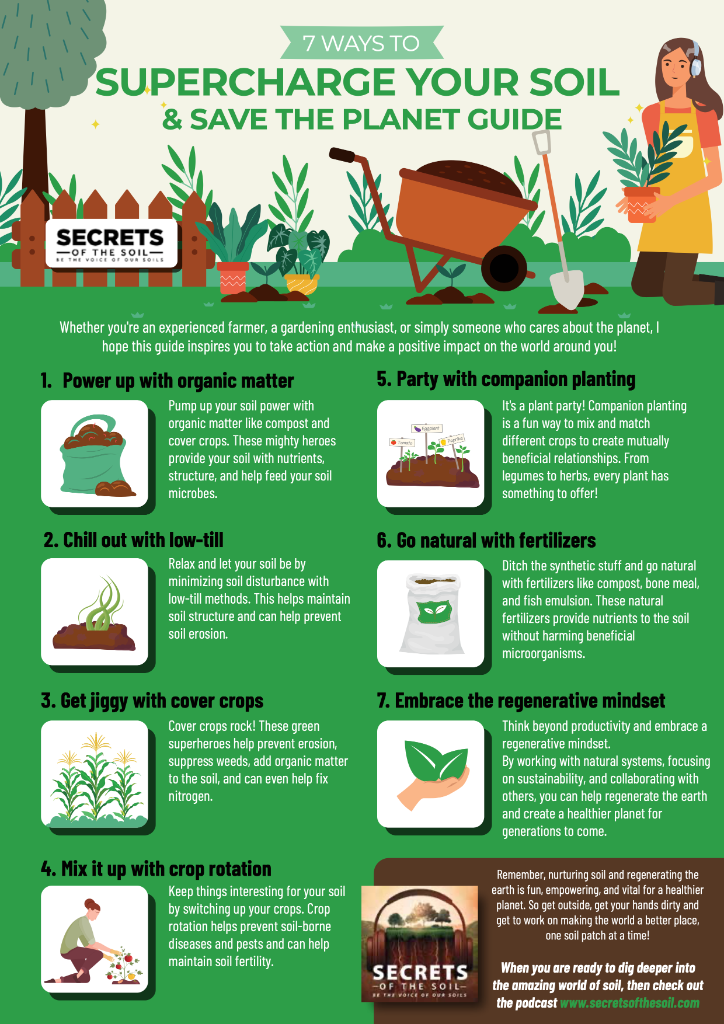
1 Power up with organic matter
Compost, mulch, cover crops — organic matter is the single best investment you can make in your soil. It feeds the microbes, improves structure, retains moisture and slowly releases nutrients over time. If you do nothing else, start adding organic matter. Your soil will do the rest.
2 Chill out with low-till
Every time you till the soil you’re disrupting fungal networks that took years to build. Low-till or no-till farming has transformed degraded paddocks around the world. The principle is simple: the less you disturb, the more the soil can organise itself. Trust the process.
3 Get serious about cover crops
Bare soil is vulnerable soil. Cover crops protect against erosion, suppress weeds, fix nitrogen and add organic matter when they’re slashed back in. Think of them as a living mulch — working for you even when the main crop isn’t in the ground.
4 Mix it up with crop rotation
Growing the same crop in the same spot year after year depletes specific nutrients and builds up soil-borne diseases. Rotation breaks those cycles. It’s one of the oldest farming techniques in existence — because it works.
5 Party with companion planting
Nature doesn’t grow in monocultures and neither should you if you can help it. Companion planting — mixing plants that benefit each other — creates diversity, confuses pests, and builds a more resilient growing system. Legumes fixing nitrogen next to hungry feeders. Herbs deterring insects. It’s basically a plant community, and community is everything.
6 Go natural with fertilisers
Synthetic fertilisers give plants a quick hit but bypass the whole microbial network that makes soil healthy long-term. Compost, worm castings, bone meal, fish emulsion — these feed the soil food web, not just the plant. Slow release, sustained results.
7 Embrace the regenerative mindset
This is the big one. All the practices above are expressions of a deeper idea: that your job as a steward of land isn’t to extract — it’s to give back more than you take. When that becomes your operating principle, every decision on the land starts to shift.
“Nurturing soil isn’t a hobby or a trend. It’s one of the most important things any of us can do for the future.”
If any of this has lit a spark, go deeper. The Secrets of the Soil podcast is 89 episodes of exactly this kind of conversation — with farmers, scientists and soil lovers who are living these principles every day.
📄 Want the visual guide? Download the full infographic:
⬇ Download the Guide